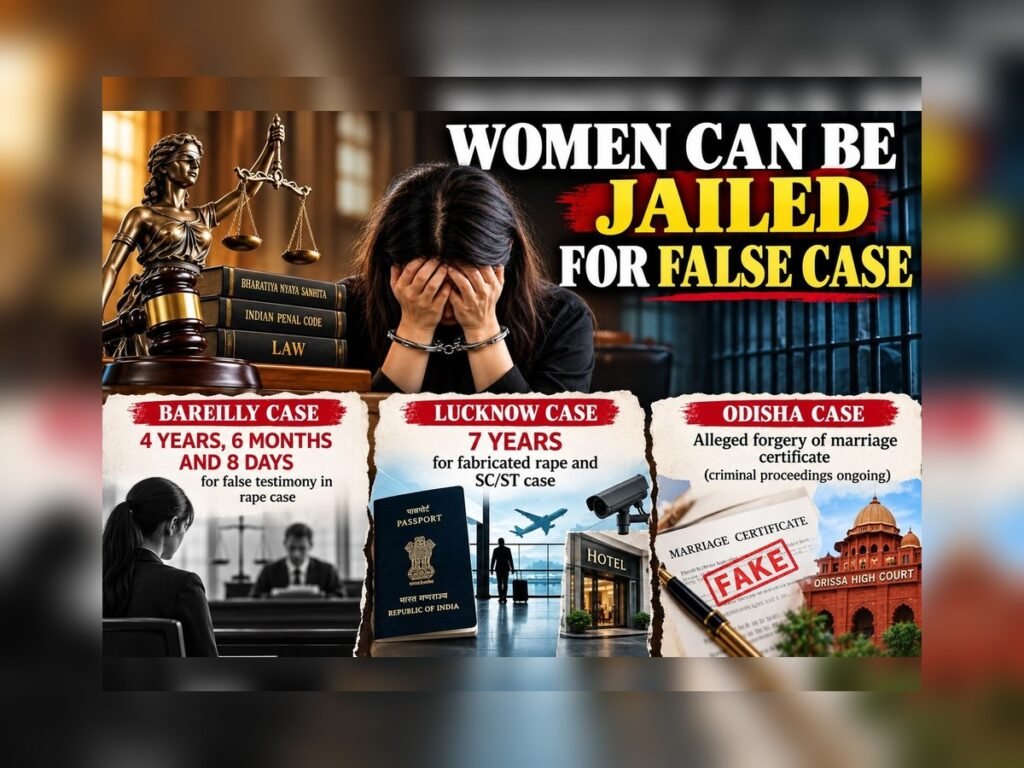
Yes. Indian criminal law has no gender-based exemption. Anyone, including a woman, can be prosecuted and imprisoned if a court finds that she deliberately gave false evidence, fabricated a case, or forged documents. But a case that fails is not necessarily a false one. Liability arises only when the prosecution proves the specific ingredients of the offence.
Three recent cases from Uttar Pradesh and Odisha show how courts have handled this.
Bareilly: Sentence Matching the Time the Accused Spent in Jail
In State of U.P. v. Nisha (2024), a woman had supported a 2019 prosecution alleging that a young man, Ajay alias Raghav, had kidnapped and raped her. He spent 1,653 days (4 years, 6 months and 8 days) in custody. At trial, she retracted her version in cross-examination and said no such crime had occurred. The court acquitted him and proceeded against her for false testimony.
As reported, the Bareilly Sessions Court convicted her under Section 195 IPC and sentenced her to 4 years, 6 months and 8 days, the same period the accused had been jailed. It also imposed a fine of ₹5,88,822.47, payable to the man, calculated using the state’s daily wage for an unskilled worker. Non-payment would mean six more months in prison.
The punishment rested on a finding about her testimony, not merely on the collapse of the original case.
Lucknow: Seven Years for a Fabricated Complaint
In a reported Lucknow case, Rangoli Gautam was convicted under Sections 182, 193 and 211 IPC for making rape and SC/ST Act allegations against a man who was allegedly outside India at the time. The court reportedly relied on immigration records, hotel records and CCTV footage. She was sentenced to seven years’ imprisonment and fined ₹52,000.
Odisha: Proceedings Allowed to Continue, No Conviction
This one is different. In June 2026, the Orissa High Court refused to quash criminal proceedings against Puspanjali Swain, accused of forging a man’s signature on a Special Marriage Act certificate and then claiming interim maintenance as his wife. A government handwriting expert reportedly found the signature did not match his admitted ones, and the court noted irregularities in the marriage registration.
The High Court only held that there was enough material for the case to go to trial. There has been no conviction or sentence.
What the Law Covers
Depending on the facts proved, offences may include:
- giving or fabricating false evidence
- knowingly giving false information to a public servant
- instituting false criminal proceedings with the required intent
- forging documents, or using forged documents as genuine
- other deliberate interference with the administration of justice
The applicable provision depends on the date of the conduct. The Bharatiya Nyaya Sanhita (BNS) replaced the IPC for offences committed on or after 1 July 2024, while earlier conduct is still dealt with under the IPC.
False vs. Unproved
An acquittal means the prosecution could not prove guilt beyond reasonable doubt. It does not mean the complainant lied. A separate prosecution for false evidence or a false accusation must independently establish intent and the other legal ingredients. Headlines like “woman jailed because her rape case failed” are therefore misleading. The accurate version is that a woman was convicted after a court found she committed a specific offence involving false evidence or fabrication.
This distinction protects accused persons and genuine complainants alike.
Why Objective Evidence Matters
The Lucknow and Odisha matters turned on verifiable material: immigration and travel records, CCTV, hotel records, handwriting analysis. Courts may also weigh phone and digital records, medical and forensic evidence, documents, and testimony given during investigation and trial.
Conclusion
The law protects genuine complainants, but deliberately fabricating evidence or misusing legal process is itself an offence, whoever commits it. Only one of these three cases, Bareilly, is well documented in a reported conviction. The Lucknow sentence and the Odisha order should be read in the actual judgments.
This article is for general information and is not legal advice. Outcomes depend on the facts, evidence and law in each case.