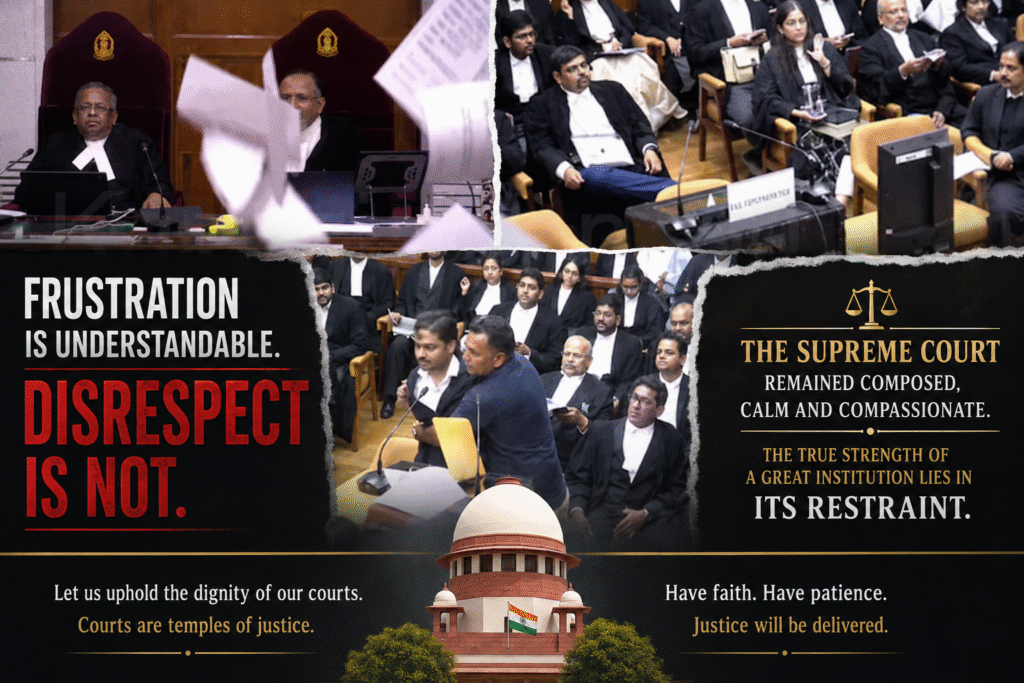
The recent incident in the Hon’ble Supreme Court of India, where a party appearing in person hurled abusive remarks and threw papers inside the courtroom, has understandably sparked intense debate.
As lawyers, we witness the emotional and financial toll that prolonged litigation can take on litigants. Therefore, I can understand the frustration that may have led to such conduct. The Hon’ble Court itself responded with remarkable restraint and compassion.
However, there is an important distinction between understanding frustration and condoning misconduct.
The Hon’ble Supreme Court is not merely the highest court of the country; it is the constitutional guardian of our democracy. Every court, irrespective of its hierarchy, deserves the highest degree of respect. However aggrieved one may be, the sanctity of a courtroom can never be compromised.
Much is said today about judicial pendency and court vacations. Before criticising, I invite everyone to spend just one week inside a courtroom. Observe judges hearing emotionally charged disputes for hours together—day after day—where every decision may affect someone’s liberty, livelihood, family, or reputation.
Judges are not machines. They are human beings entrusted with an extraordinary constitutional responsibility. Mental fatigue can affect anyone. Court vacations are not a privilege; they are an institutional necessity to ensure that justice continues to be delivered with clarity, patience, and fairness.
Similarly, the issue of pendency must be viewed objectively. The existing judges are not the cause of the backlog. They continue to work under immense pressure despite an ever-growing docket.
The real solution lies in strengthening judicial infrastructure, filling vacancies promptly, and increasing judicial strength—not in blaming those already carrying the burden.
One aspect of this incident deserves special appreciation. Despite the unfortunate conduct displayed in the courtroom, the Hon’ble Supreme Court chose the path of restraint over retribution. This reflects the true strength of a great institution. Justice is not only about enforcing discipline; it is also about exercising compassion where appropriate. The Court’s response reaffirmed that firmness and empathy can coexist, enhancing the dignity of the institution rather than diminishing it.
Every litigant has the right to be disappointed. Every citizen has the right to criticise. But neither disappointment nor criticism should ever cross the line into disrespect.